The building becomes the interface.
No camera feed. No dashboard. The care home itself starts to carry context.
Care-home awareness layer
Swiss Sentinel gives care homes a quiet awareness layer — without cameras, required wearables or another dashboard. The building carries context to the team before another screen is needed.
No camera feed. No dashboard. The care home itself starts to carry context.
The doorway matters without exposing the person behind it.
Spatial continuity connects room, corridor, lounge and staff point.
No alarm theatre — just the right person oriented to the right place.
A quiet operational awareness layer for safer handovers and family reassurance.
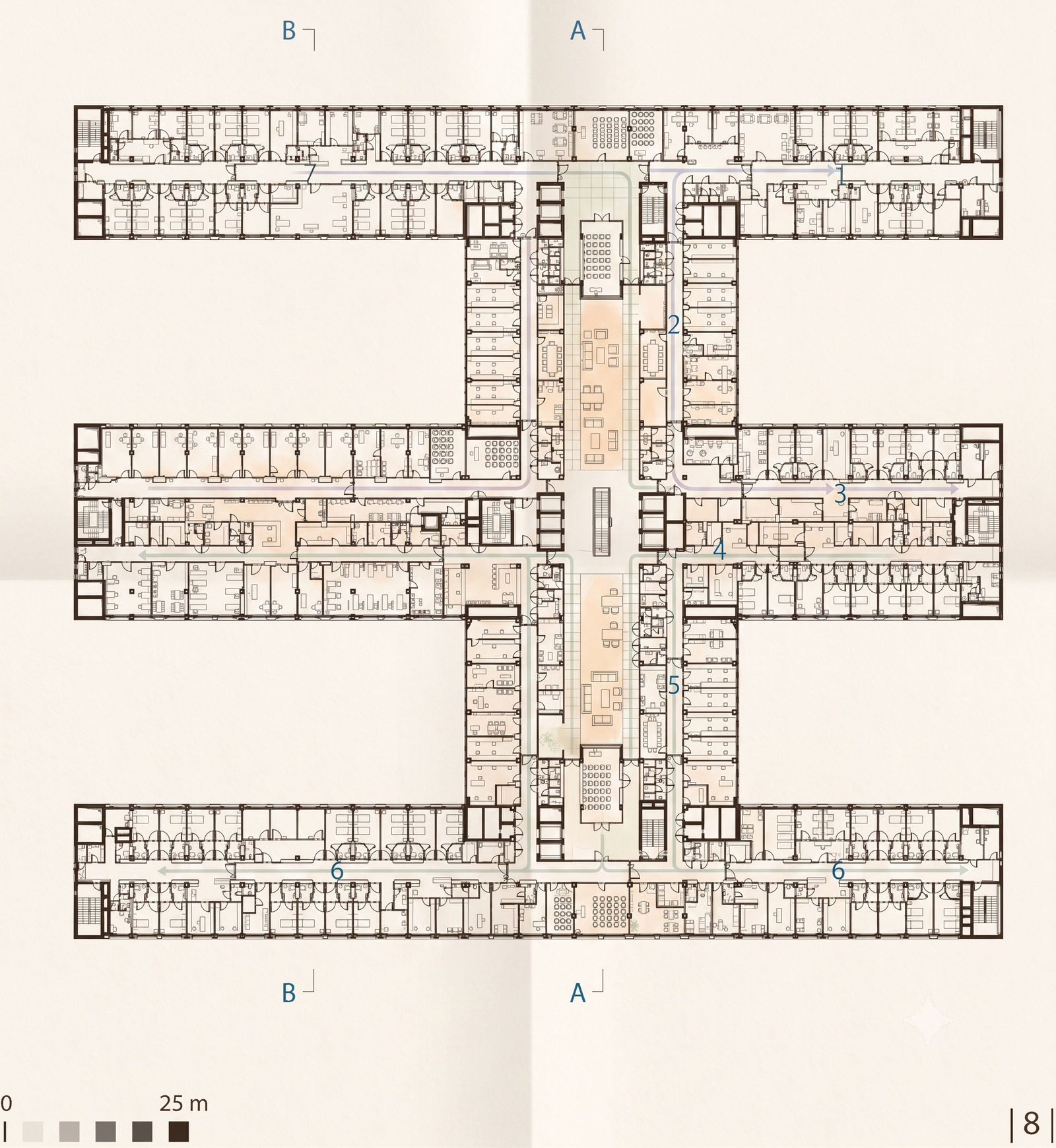
Care context
Not a camera view. Not a device-first system. A care home forming reviewable context.
Scroll to open the evidence layer.01 / Awareness
Swiss Sentinel frames room and building context as privacy-preserving operational awareness. Care teams see reviewable context, not intrusive monitoring.
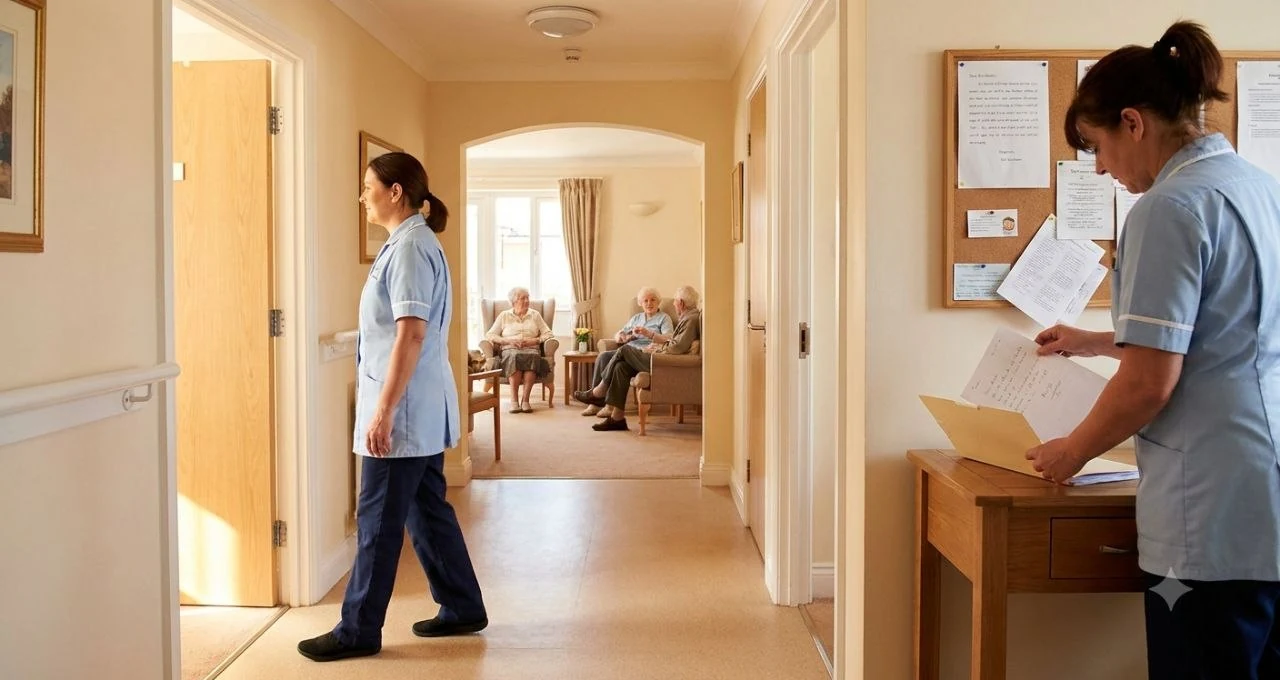
02 / Continuity
Wearables can help, but adoption is fragile. In one older-adult study, 25.6% did not express interest in using wearable technology. In a dementia GPS-tracker study, 36.6% of participants never entered the active tracking phase after consent, and a further 24% dropped off during the study.
Outcome: a wearable can be useful when it is worn, charged and accepted — but care-home awareness cannot make that the single point of failure. The building layer keeps context available when the device layer is absent.
Source context: older-adult wearable interest study; dementia GPS tracker study.
03 / Private-room context
Closed-door and private-room moments are presented as candidate context for staff review: unusual stillness, posture context or a possible need for attention — never automatic conclusions.
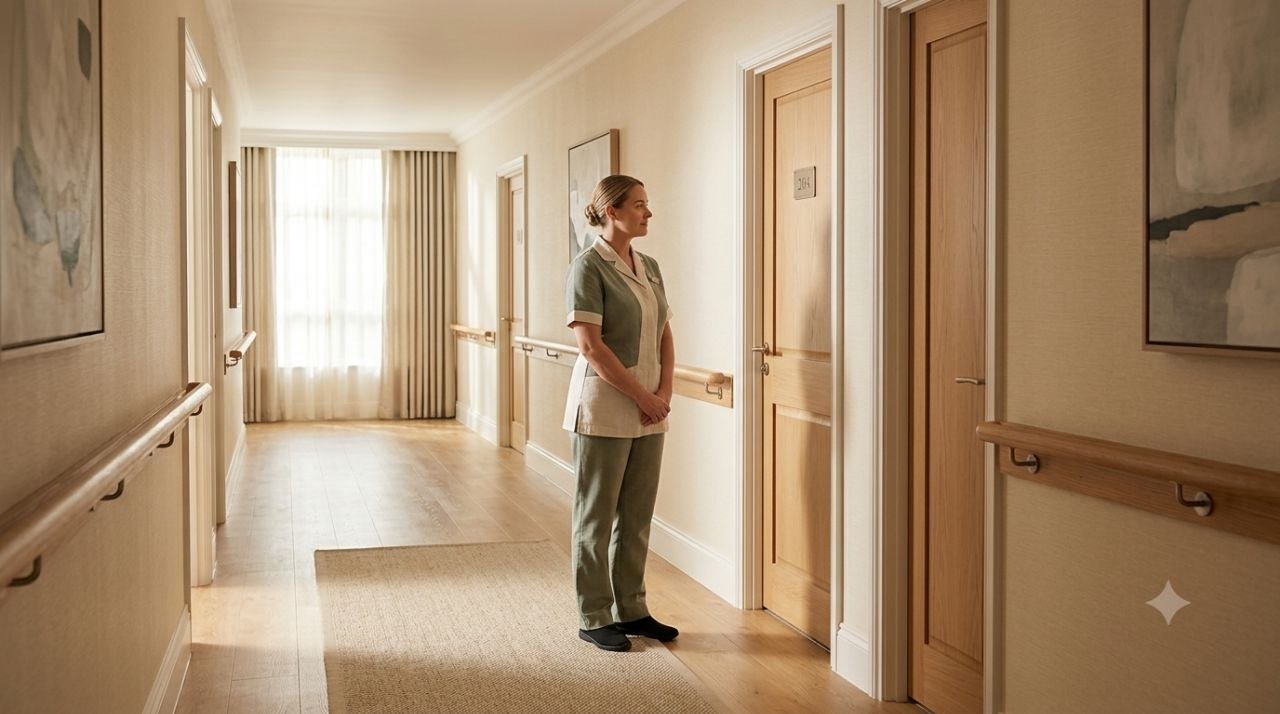
04 / Limited mobility
For people with severe motor impairment, including cerebral palsy, spinal cord injury, brainstem stroke or locked-in states, communication may depend on the movement they can still control: eye gaze, head movement, residual speech, switch access or a small intentional gesture.
Care context: Swiss Sentinel should treat such movement as a candidate request for staff review — not a diagnosis, risk score or automatic emergency claim. The value is a calm pathway from observed context to human verification.
Source context: NIH/PMC access-interface review; AAC severe motor impairment state-of-science review; gaze-based assistive technology study; 2025 PubMed scoping review.
05 / Daily rhythm
Rest, room time, meals, lounge participation and staff interaction become reviewable daily rhythm — showing what changed gently over time, without cameras, clinical labels or raw monitoring feeds.
06 / Family reassurance
Short check-ins, longer conversations, shared activities and night responses become family-safe reassurance after staff review — turning quiet care work into a respectful daily rhythm families can understand and trust.
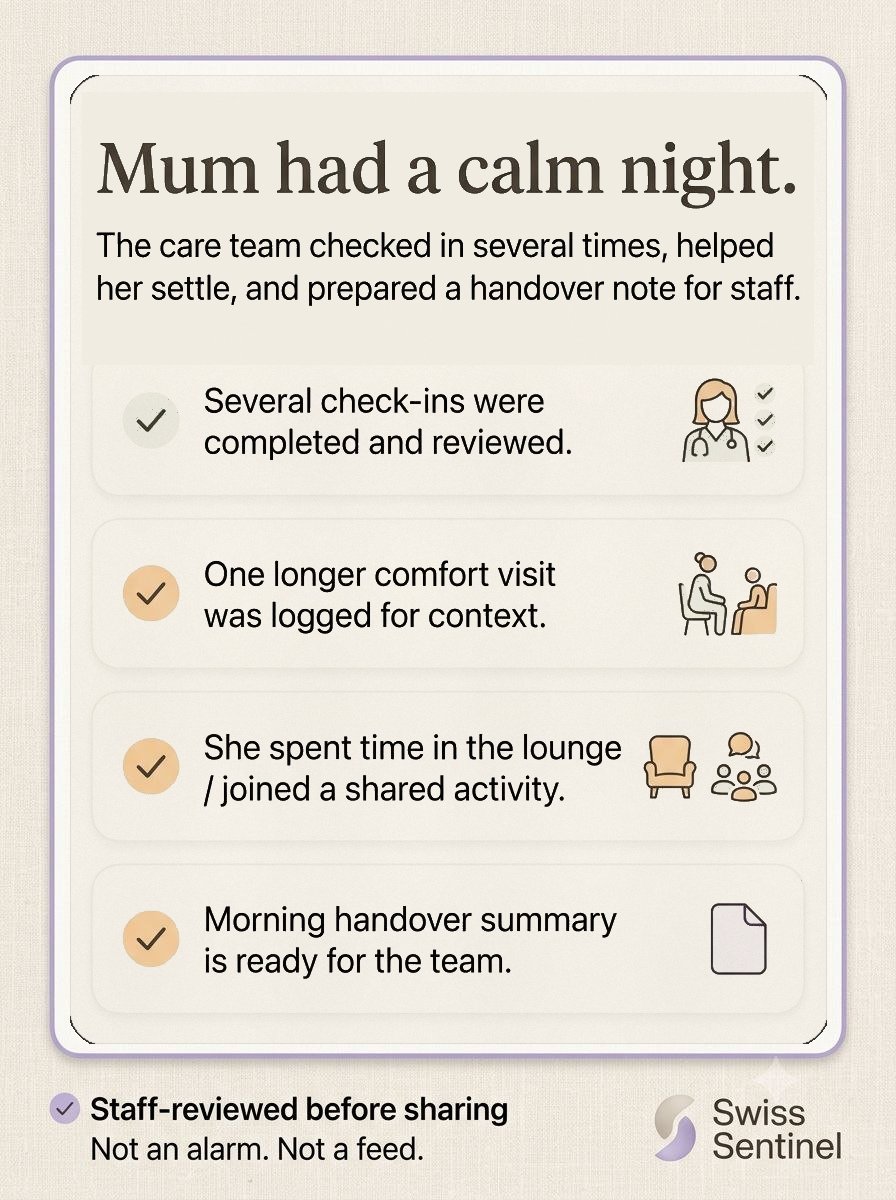
07 / Staff-in-the-loop
Candidate context is only useful when it becomes a human-reviewed operational record. Swiss Sentinel keeps staff in control of what becomes evidence.
01 / Candidate context
02 / Staff review
The care lead checks the context, edits the note if needed, and decides what becomes part of the record.
03 / Evidence support
08 / One timeline
The value is ownership: who was alerted, who acknowledged, who attended, and what was handed over.
Staff
Reviewed note, next-round follow-up and the reason it matters — ready before shift change.
Manager
Who was alerted, who acknowledged, who attended, and what was reviewed — in one calm sequence.
Family
A plain-language summary of care activity after staff review — not surveillance or panic.